






.png)










.png)

























Join 1M+ Readers Who Never Miss a Headline.
Stay informed wherever you are — join our growing community of readers and followers across social platforms.
Choosing a Search Firm
Compensation Intelligence
Board & Governance
Succession Strategy
AI Leadership Trends
Talent & Workforce Trends
AI Leadership Appointments
Compensation Changes
Big Tech Succession
CHRO & CPO Appointments
CEO Transitions
Board Members and Governance Committees
Operating Partners at private equity and venture capital firms
CHROs and Chief People Officers
HR leaders responsible for executive hiring
CEOs and Founders
April 30, 2026

Accenture announced this month an investment in General Robotics, an AI-native company building a unified intelligence platform for industrial and logistics robots. The deal, made through Accenture Ventures, pairs the consulting firm's manufacturing client base with General Robotics' GRID platform, which connects robots from different hardware vendors into a single orchestration layer using modular AI, cloud-based coordination, and simulation training. The financial terms were not disclosed.
The announcement is one of several in recent weeks that signal a shift in how industry is approaching AI-powered automation. After years of pilots, proofs of concept, and carefully managed demonstrations, autonomous robots are being deployed in real operating environments at scale, in automotive factories, fulfillment centers, logistics networks, and construction sites. The question is no longer whether the technology works well enough to leave the lab. It is whether organisations can deploy it fast enough and at enough scale to justify the investment and absorb the operational change that comes with it.
Physical AI-powered robotics address issues including workforce constraints, challenged factory and warehouse productivity, and continuously rising capital and operational costs, according to Prasad Satyavolu, Accenture's global lead for manufacturing and operations. But piloting robotic systems takes too long, is expensive, and often is not scalable or repeatable across a network of facilities.
That last point is the one the Accenture-General Robotics partnership is directly targeting. General Robotics' GRID platform focuses on modular, reusable AI skills, cloud-based orchestration, simulation training, and data sovereignty, rather than relying on static programming. The intent is to allow organisations to deploy robots faster and continuously adapt them as tasks become more sophisticated.
Ashish Kapoor, CEO and co-founder of General Robotics, described the core problem as a lack of unified intelligence infrastructure. While robotics hardware and AI models advance at a rapid pace, the gap between capability and real-world impact is constrained by the absence of a system that connects robots, agents, and AI models through a single platform.
The deployment bottleneck Kapoor describes is a recurring theme across industrial AI. Hardware capability has outrun the ability of most organisations to integrate, orchestrate, and manage it at scale. The partnership is oriented toward shortening that gap through shared infrastructure rather than custom-built solutions for each client.
The investment arrives into a market that is expanding across nearly every measure. The global market value of industrial robot installations has reached an all-time high of $16.7 billion, according to the International Federation of Robotics, with future demand driven by technological innovation, market forces, and new fields of application.
The autonomous mobile robots segment, which covers the self-navigating robots increasingly common in warehouses and manufacturing facilities, is valued at approximately $5.18 billion in 2026 and projected to reach $10.56 billion by 2031, growing at a compound annual rate of just over 15%.
Labor shortages are a consistent driver across geographies. The International Federation of Robotics notes that employers across the world are struggling to find people with the specialized skills required for industrial work, and that adopting robotics is a primary strategy for addressing this. At the same time, the AI-driven autonomy fundamentally changes the safety considerations, requiring new approaches to testing, validation, and human oversight.
Amazon surpassed 1 million deployed robots across its operations by July 2025, cutting travel time per pick by 10% through its DeepFleet fleet intelligence system, demonstrating that mobile automation at scale is capable of quadrupling throughput using the same headcount. The figure has become a benchmark cited by logistics operators assessing whether to accelerate their own automation programs.
The robots entering factories and warehouses in 2026 are not the same category of machine as the ones that dominated industrial automation a decade ago. Fixed-path automated guided vehicles and single-purpose robotic arms are still deployed in volume, and remain the appropriate tool for many high-precision, high-repetition tasks. What is new is the addition of a layer of contextual intelligence that allows robots to perceive, reason, and adapt rather than simply execute a predetermined sequence.
The International Federation of Robotics identifies agentic AI as a key trend for 2026, describing it as a hybrid approach combining analytical AI for structured decision-making and generative AI for adaptability, aimed at making robots capable of working independently in complex real-world environments.
At Hannover Messe 2026, NVIDIA and its partners demonstrated AI-driven manufacturing in operation. A humanoid robot running NVIDIA's Jetson Thor edge AI module completed autonomous logistics operations in a first proof of concept inside a Siemens blueprint autonomous electronics factory in Germany. The simulation-first development approach used for that deployment compressed what typically takes up to two years of hardware development into seven months.
The compression of development timelines is significant. A recurring constraint on industrial robotics deployment has been the time required to train, test, and validate robot behavior before it can be trusted in a live production environment. Simulation platforms that allow robots to accumulate billions of virtual interactions before they touch a physical object are reducing that constraint substantially, which in turn accelerates the speed at which new deployments can be brought to operating standard.
Boston Dynamics has described its near-term strategy as focused on specific, repeatable applications, sequencing, machine tending, warehouse picking, rather than general-purpose deployment. The reasoning is that refining the process for a defined task allows it to be replicated at scale in a way that is less customized and more deployable. Building toward general-purpose robots requires learning from those first applications before the tools exist to let customers design their own workflows.
The most visible development in industrial robotics in 2026 is the arrival of humanoid robots in commercial production and deployment. For most of the past decade, humanoid platforms were primarily demonstration machines, impressive in controlled conditions and largely impractical in real operating environments. That has begun to change.
Boston Dynamics unveiled the production version of its electric Atlas at CES 2026, a fully electric enterprise-grade humanoid robot measuring 6.2 feet tall with a 7.5-foot reach, capable of lifting up to 66 pounds and operating across a wide temperature range. All 2026 units are committed to Hyundai's Robotics Metaplant Application Center and Google DeepMind, with broader customer orders opening in 2027.
Atlas features autonomous self-swappable batteries, allowing it to navigate to a charging station, swap its own battery, and return to work without human intervention, enabling continuous operation. The robot's fleet learning capability means that once one unit learns a task, the skill can be replicated across the entire fleet.
Figure AI's Figure 02 has already supported more than 30,000 vehicles at BMW's Spartanburg facility, logging over 1,250 hours and handling more than 90,000 parts in a real production pilot, with expansion to the Leipzig plant planned. Agility Robotics' Digit is deployed at Toyota Motor Manufacturing Canada for RAV4 logistics operations under a robotics-as-a-service model. Both represent transitions from the pilot phase to sustained production deployment.
Unitree shipped more than 5,500 humanoid units in 2025 and is targeting between 10,000 and 20,000 in 2026, representing the highest volume production trajectory among Western and Asian competitors outside China's domestic market.
The Chinese market is moving at a different pace entirely. Shanghai-based Agibot reached 10,000 humanoid robots shipped cumulatively on March 28, 2026, and has stated a target of 100,000 units deployed in factories and warehouses globally by the end of the year. Independent verification of performance data at that scale is limited, and the target is described by analysts as aggressive even by Chinese manufacturing standards. What is not in doubt is that Chinese humanoid manufacturers have opened a production volume advantage that Western competitors have not yet closed.
Procurement teams evaluating humanoids should treat this as an emerging category with genuine long-term potential rather than a near-term drop-in replacement for installed automation. No current humanoid platform yet operates at automotive-line production rates. Several well-funded platforms have demonstrated autonomous material handling, bin picking, and simple assembly, but cycle times and reliability levels remain below what traditional industrial robots cleared a decade ago.
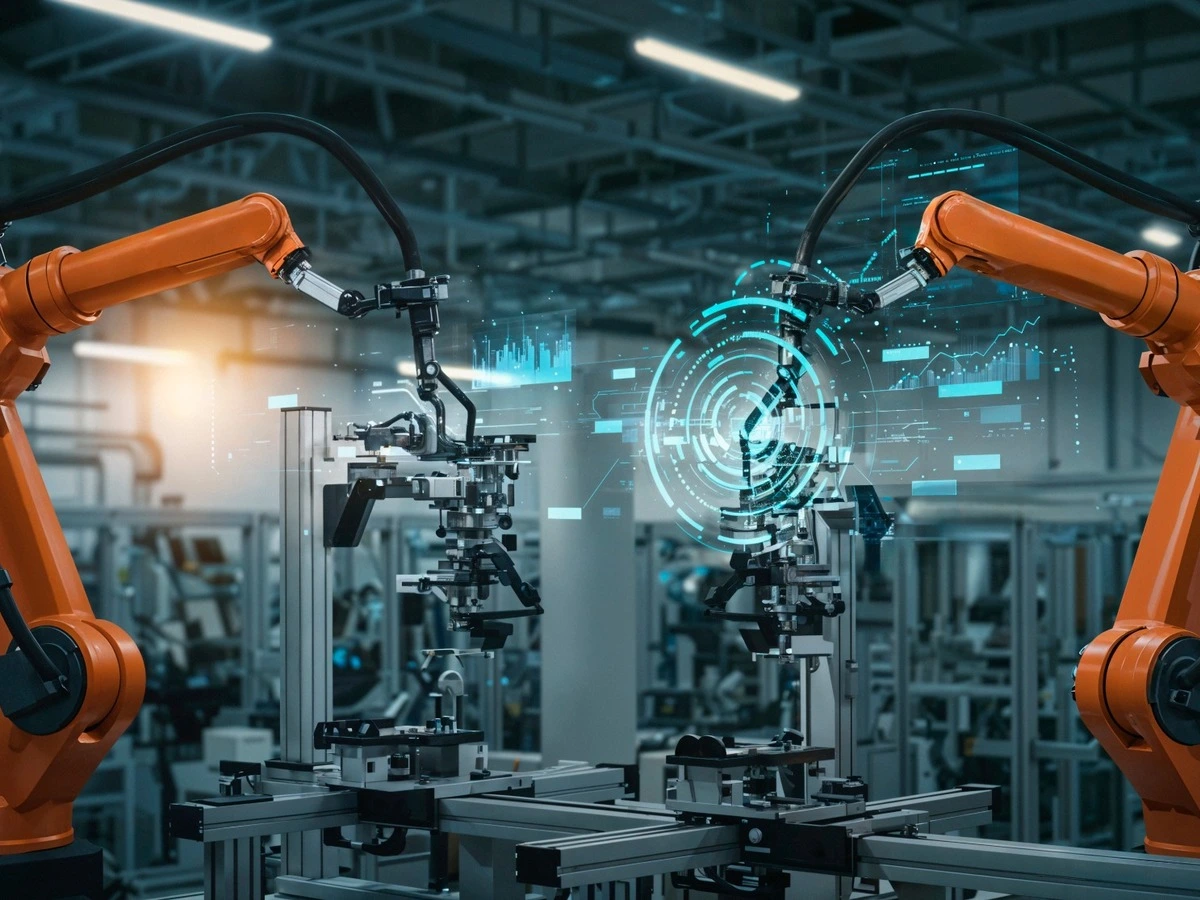
Beyond any individual robot's capability, the more significant shift in 2026 is the move toward coordinated fleets of robots working together as a system. Single-robot deployments are giving way to orchestrated networks where multiple machines share data, divide tasks, and adapt collectively to changing conditions.
Fleet-level algorithms optimize traffic flow and task allocation across deployments, reducing redundant travel and improving overall throughput. Amazon's DeepFleet system crowd-sources route data from the entire fleet to cut redundant travel. A joint 5G-robotics testbed demonstrated 15% energy savings when compute loads shifted to edge servers.
Fleet management software is leveraging AI-powered coordination and swarm intelligence to orchestrate diverse fleets of collaborative mobile robots, piece-picking robots, and sortation robots. Interoperability standards including VDA 5050 and the MassRobotics interoperability standard are addressing vendor lock-in, a key concern for large operators managing multi-vendor deployments.
The robotics-as-a-service model is accelerating fleet adoption by removing the capital barrier of purchasing hardware outright. Exol, backed by a $7.5 billion commitment from SoftBank Group and Symbotic, is building a nationwide automated fulfillment network offering robotic fulfillment infrastructure as a flexible, scalable service with no large upfront financial commitment. The company describes itself as building the first robot-first fulfillment network that operates as infrastructure. The model allows businesses without large automation budgets to access enterprise-grade robotics capacity and scale usage with demand.
Hyundai Motor Group's robotics solutions are already operational across several industries, with partners including DHL, Nestlé, and Maersk, as the group works toward integrating Atlas robots into its global manufacturing value chain and expanding into logistics, energy, construction, and facility management.
The capital flowing into the sector reflects the conviction that current deployments are the beginning of a much larger structural shift rather than a mature market settling into stable growth.
Waymo raised $16 billion in the most recent period tracked, at a reported post-money valuation of $126 billion, to fund faster global expansion including planned entry into London and Tokyo in 2026. Bedrock Robotics, which upgrades heavy construction equipment with autonomy systems enabling coordinated excavation and earthmoving fleets, raised $270 million in a Series B round co-led by CapitalG and the Valor Atreides AI Fund. Apptronik's $520 million Series A extension values the Apollo robot maker at approximately $5.3 billion, signaling that industrial humanoids are now treated as a credible institutional asset class rather than a speculative bet.
Strategic investors from the automotive and industrial world are writing large checks, with Mercedes-Benz, John Deere, NVIDIA, Uber, and Volvo all participating in rounds during the most recent reporting period, suggesting that original equipment manufacturers are using venture capital as a supply-chain hedge as well as a financial investment.
The question for manufacturers is no longer whether to adopt AI, but how fast and at what scale. NVIDIA's framing at Hannover Messe 2026 was that the factory of the future is not a concept; it is being built now.
The experts assembled at Davos 2026 for the World Economic Forum's panel on physical AI offered a consistent view: the foundational technical era of robotics is over. The core technical groundwork for physical AI is largely complete, and the industry's full impact will be realized as these systems move from isolated industrial zones into the complexity of everyday life. The hardest advances in robotics are behind us, according to the consensus at Davos. The coming decades will focus on improving manipulation, risk assessment, and contextual reasoning as robots shift from automating in isolation to collaborating with humans in real time.
The challenge that remains is the one that always follows a technology transition from proof of concept to mass deployment: the operational, organisational, and human dimensions of integration. Robots that can perceive and reason require new approaches to workforce design, liability assignment, and safety validation. Fleets that coordinate across facilities require data infrastructure and orchestration software that most organisations are still building.
A key distinction at the current stage separates robots operating in rule-based ways, where every motion is repetitive and predictable, from training-based systems where AI enables handling of tasks with more variability, and context-based systems that use multimodal large models to act appropriately in unpredictable situations. The transition from training-based to context-based intelligence is what allows physical AI to move into unstructured environments and collaborative human settings.
The deployment wave underway in 2026 is primarily in the training-based phase, with context-based capability arriving unevenly across platforms and applications. The gap between what the most advanced systems can demonstrate in controlled conditions and what can be reliably deployed in production at scale remains real. Closing it is where the industry's capital, research, and engineering effort is now concentrated.











Stay informed wherever you are — join our growing community of readers and followers across social platforms.
Choosing a Search Firm
Compensation Intelligence
Board & Governance
Succession Strategy
AI Leadership Trends
Talent & Workforce Trends
AI Leadership Appointments
Compensation Changes
Big Tech Succession
CHRO & CPO Appointments
CEO Transitions
Board Members and Governance Committees
Operating Partners at private equity and venture capital firms
CHROs and Chief People Officers
HR leaders responsible for executive hiring
CEOs and Founders

.svg)
.svg)